Product··7 min
Cedar versus pressure-treated: when each one wins.
A straight comparison on cost, life, fasteners and appearance, and the five or six cases where each is the clear call.
NorthStar
/Company
A straight comparison on cost, life, fasteners and appearance, and the five or six cases where each is the clear call.
The choice between cedar and pressure-treated pine is the first decision on any wood-fence project, and it’s the one most yard staff hand-wave on. Here’s the decision in full, without the sales gloss.
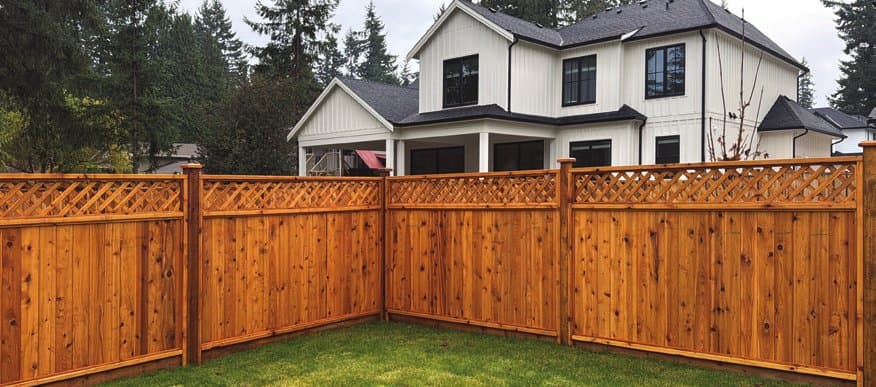
Cedar (Western Red Cedar, the species we run) is naturally rot-resistant and dimensionally stable. It doesn’t need a chemical treatment to survive Canadian weather; the tree evolved in a rainforest. The heartwood carries natural oils (thujaplicins) that poison the fungi and bacteria that rot other woods. It holds its shape through freeze-thaw cycles better than pine. It ages to a uniform silver-grey in about 18 months and stays there for decades. It’s softer than oak but harder than pine, so it takes a fastener without splitting and planes cleanly at the mill.
Pressure-treated (ACQ-treated Southern Yellow Pine, what we use) is the workhorse. It’s chemically treated with alkaline copper quaternary compounds that make the wood inhospitable to rot and insects. It starts green from the treatment, shifts to a warm amber over the first summer, and eventually weathers silver-grey like cedar, but the process takes closer to 2–3 years and isn’t as uniform. It’s denser than cedar, so it holds fasteners well, but it’s more prone to checking (surface splitting) as it dries down.
Cost is the biggest real difference. On a 100-foot perimeter fence, a pressure-treated Good Neighbour run will cost a dealer roughly 40–50% less at pallet than the cedar equivalent. That’s not a small gap, and it’s the reason PT panels dominate rental property and hidden-run applications.
But cost isn’t the whole spreadsheet. Cedar lasts longer above grade: 25 to 40 years is reasonable for a cedar panel on properly drained posts. Pressure-treated lasts 15 to 25 years before the picket faces start to check badly enough to need replacement. Per-year-of-service, the two species end up closer than the sticker price suggests.
Fasteners are where the two species diverge on install. Cedar takes hot-dip galvanised ring-shank nails cleanly, with no reaction and no streaking. Pressure-treated reacts with galvanised steel. The ACQ chemistry strips the zinc coating and then the fastener rusts, which stains the wood and eventually fails. The fix is stainless steel. Every ACQ-treated panel in our catalogue ships with stainless fastener specs for that reason, and every box of our fasteners is marked for the panel line it matches. If you’re building a PT fence with galvanised nails you inherited from a cedar job, expect rust streaks within 18 months.
Appearance is the subjective part, but there’s a pattern. Cedar weathers pretty. The silver-grey is even and reads as aged-on-purpose. Pressure-treated weathers unevenly: the greener portions hold the treatment tint longer, the faster-drying portions go silver sooner, and the mix is patchy for the first couple of years before it settles. Some installers stain the PT amber to skip that middle phase.
Where cedar wins outright: pool enclosures (the appearance matters, and rot-resistance in a chlorine-vapour environment pays back), front yards facing the street, heritage or infill neighbourhoods where the line is visible from the public realm, any backyard where the owner plans to live in the house more than 10 years, and any wet site (low-lying yards, lake-effect moisture, lots with poor drainage).
Where pressure-treated wins outright: rental properties, perimeter-only commercial fencing, long rural runs where budget dominates, anywhere the fence is functional rather than decorative, hidden sections of a larger run where nobody will see the face long enough to care about weathering.
And one grey-zone case: the back fence of a property that butts onto a creek or wooded lot. Cedar lasts longer. Pressure-treated is nearly invisible behind the treeline. Cost wins most of these, which is why half the suburban subdivisions in the GTA are bordered by PT shadowbox on the back line and cedar on the side yards. That split spec is normal and it’s the right call.