Craft· · Updated ·5 min
Why cedar.
The longer version of why the catalogue is Western Red Cedar, not pressure-treated pine, and the two places cedar is the wrong answer.
NorthStar
/Company
The longer version of why the catalogue is Western Red Cedar, not pressure-treated pine, and the two places cedar is the wrong answer.
Most wood fence in Canada is pressure-treated pine shipped up from the southern United States. It’s cheap, and if you’re putting up a line for a rental property it’s probably the right call. For everything else, it’s worth a longer look at Western Red Cedar, and at the two places where cedar is honestly the wrong answer.
Western Red Cedar is naturally durable because of what’s in the wood, not what’s injected into it. The heartwood carries oils (thujaplicins) that rot organisms and insects avoid, which is why cedar survives outdoors for decades without a chemical treatment. Pressure-treated pine gets its resistance from a copper compound forced into the outer layer of the board; cut it, and you’re asked to brush preservative on the fresh end. Cedar is the same wood all the way through.
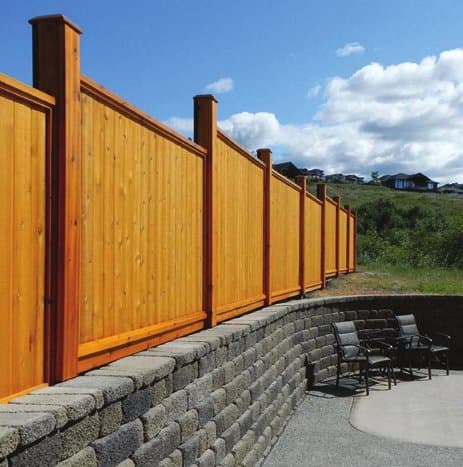
The property that matters most in a fence panel, though, is dimensional stability. Cedar has one of the lowest shrinkage rates of any softwood you can buy in Canada, roughly half the movement of pine across a season of soaking and drying. Ontario weather is a wet spring, a dry August, and forty freeze-thaw swings a winter; a species that stays put through that keeps a panel square, keeps boards from cupping off the frame, and keeps the reveal at the top of the fence line even. It’s also light: a cedar panel hangs with two people comfortably, and puts less standing load on the posts than the same panel in treated pine, which comes out of the store heavy with treatment moisture and loses that water (and its straightness) over its first summer.
It works like a carpenter’s wood. Cedar cuts clean with ordinary tools, holds fasteners well for its weight, and takes stain evenly. Left alone, it ages to a soft silver-grey in about a season and then more or less stops changing. If you want to keep the amber colour instead, use a penetrating UV-blocking stain in the first year and expect to renew it every two to three years. Greying is the only “maintenance problem” cedar has, and it’s cosmetic. The wood underneath is fine either way.
Now the honest part: where cedar loses. First, the ground. Nothing we build touches soil (panels hang between posts), but posts live in it, and in-ground durability is where pressure-treated earns its keep. A cedar fence on pressure-treated 4×4 posts is the standard, unromantic, correct combination, and it’s what we recommend. Second, pure budget lines. If the fence is a property-line formality on a rental and the budget is the spec, treated pine stick-built or our Contractor-grade panel is the honest call. Cedar’s advantages are real, but they’re paid for.
There’s one other thing: cedar is Canadian. The Western Red Cedar we build with comes from partner mills in British Columbia; the fibre arrives in Bolton and every panel is cut, framed and finished here. For a company that’s 100% Canadian owned and operated, it’s the honest default.
That’s why cedar is the heart of the catalogue: five of the nine panels. For the jobs where treated wins on budget we build two panels in premium brown pressure-treated, a solid privacy face and a shadowbox lattice top, and the wood-and-steel panels set black steel in a pre-stained wood frame. The full comparison, including when treated wins on merit rather than price, is in cedar versus pressure-treated, and the panels themselves are at /products.