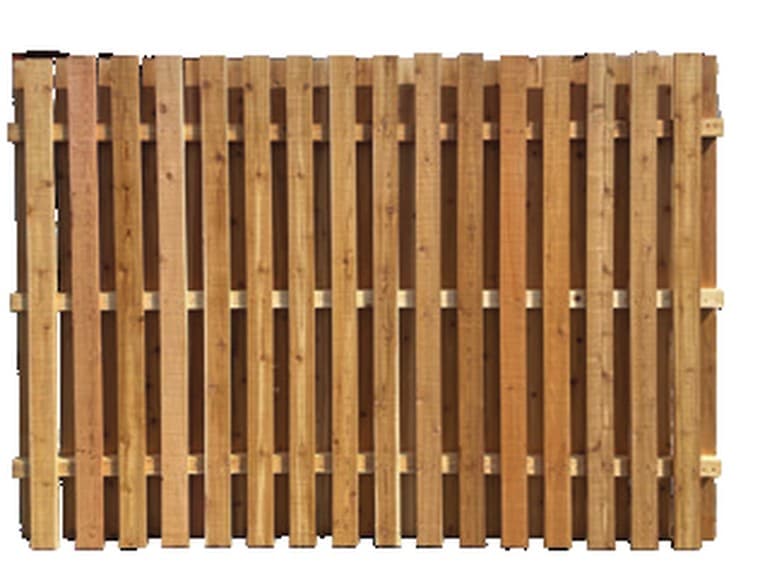
A good neighbour fence is a fence that looks the same from both sides. A standard fence has a “good” side and a “bad” side: the good side faces the street, pickets flush against the rails; the bad side faces you, exposed framing, fasteners, the rail structure. For most of the last century, that’s been the trade-off on a budget fence, and the good neighbour fence is the pattern that removes it.
The shadowbox pattern, which is what a good neighbour fence is built from, flips that. Boards alternate from side to side of the centre rail, one on your face of the fence, the next on your neighbour’s, each overlapping the gap the other leaves. The panel reads finished from either side: you get the same view your neighbour gets, and nobody spends thirty years looking at the back of someone else’s fence. A board-on-board fence is a different pattern: it overlaps all of its boards on one face of the rails and still has a back side, while a shadowbox alternates the boards between the two faces.
The overlap is also what the pattern does for privacy, and it’s worth being precise about it. Straight on, a shadowbox is as private as a solid fence, because the boards cover every gap. Walk far enough along it and there’s a narrow sight line at a sharp angle, gone as soon as you keep walking. In a real yard, standing still, you don’t see through it. If you need literally zero sight line at every angle (a pool surround, say), that’s what the Solid Privacy panel is for.
What you get in exchange is airflow, and in an open yard that matters more than people expect. A solid fence is a sail: every gust loads the boards, the boards load the rails, and the rails work the posts back and forth in their footings, which is how fences end up leaning long before the wood fails. The shadowbox bleeds wind pressure through the staggered gaps instead of catching all of it. It’s the pattern we point contractors to for exposed runs, corner lots and anywhere the fence takes weather from a field rather than another house. The gaps also let a breeze through the yard itself, which a garden appreciates in August.
There’s an etiquette dividend too, and in Ontario it’s occasionally a legal one. A line fence is usually a shared project (split cost, shared boundary), and the first argument on a shared solid fence is who gets the good side. A symmetric panel deletes the argument. Some municipalities also require the finished face of a fence to point outward toward the street or public path; a shadowbox satisfies that clause automatically, because every face is the finished face.
It costs a bit more in material than a traditional back-rail panel (more boards, tighter joinery), and every board is finished S1S2E, so there’s no rough face and no splinter side. The pay-off is a fence line that doesn’t apologise from either side.
We called the collection “Good Neighbour” because that’s literally what it does. The panel is here, with pricing: 6 ft × 8 ft nominal, a true 72″ × 96″, which matters when you’re laying out a run: measure against true dimensions, not the trade name.