Raised bed soil calculator: litres, cubic feet and bags.
Pick one of our sizes or type your own interior measurements, and say how many beds. The calculator gives the soil to the fill line in litres and cubic feet, the number of bags, the mix in thirds, and the filled weight of each bed. The formula is interior length by width by depth; one cubic foot is 28.3 litres.
Your details stay with us. We do not share contact data with third parties.
Inside the box, not outside.
Soil fills the inside, so measure between the walls, not across the outside of the boards. Our sizes are named by the outside width and length; the interior is an inch and a half less each way because the boards are 3/4 inch thick. The calculator already knows that for our sizes. For another bed, run the tape inside the box and measure the depth from the base to the line you will fill to, not to the top edge.
Volume = interior length × interior width × fill depth. In inches, divide by 1,728 for cubic feet; multiply cubic feet by 28.3 for litres. Bags = litres ÷ bag size, rounded up. Filled weight = the bed's own weight plus 75 to 100 lb per cubic foot of moist mix.
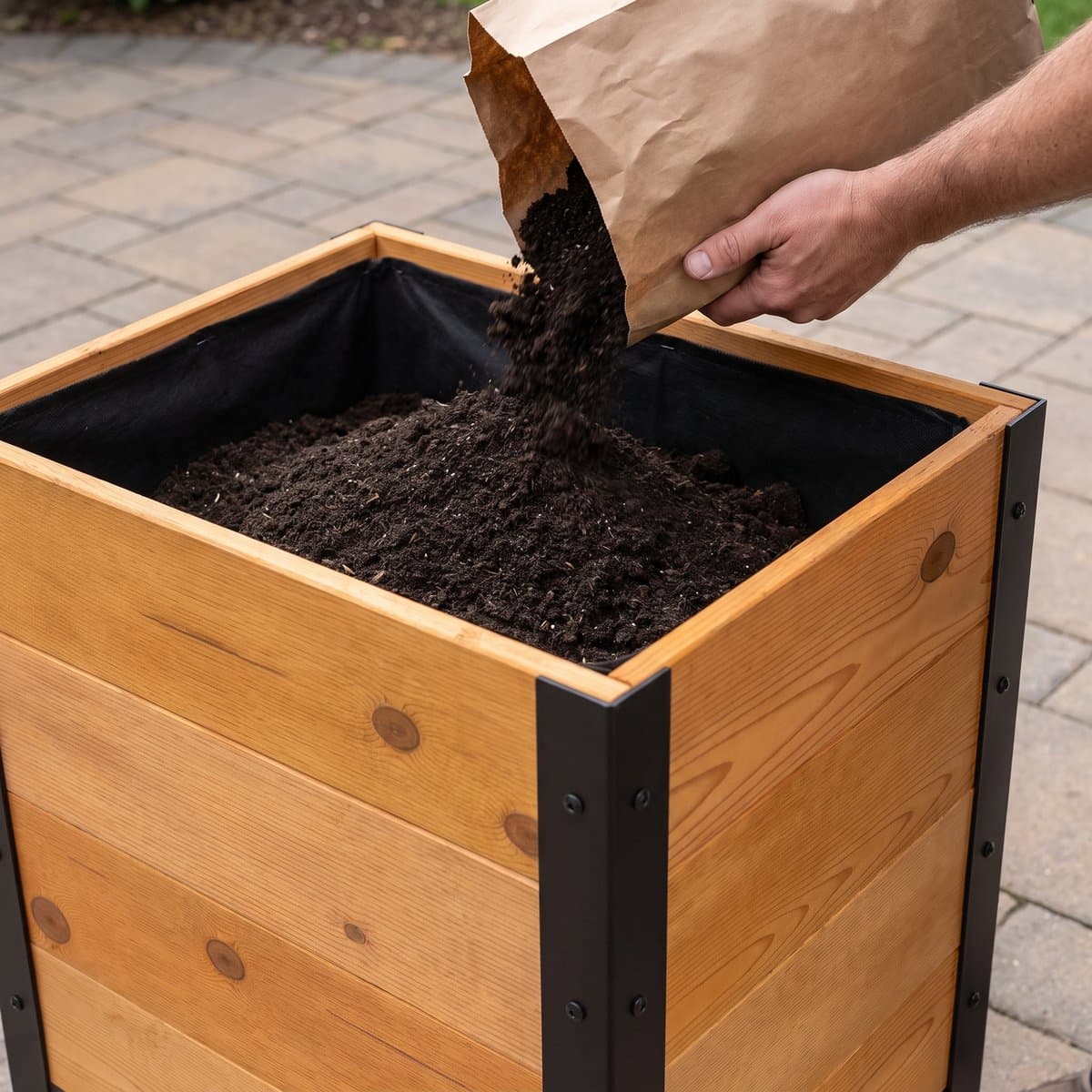
Fill to about an inch below the top board, not to the brim: soil settles a tenth to a fifth in the first month and you will top it up. Our Deep sizes have 12 inches of soil depth and the Standard sizes 8; the calculator also shows a 10 inch fill for the Deep beds, because that is how most people fill them the first year.
A mix, not garden soil.
A raised-bed mix by volume, not garden soil: one third compost, one third peat or coir, one third coarse vermiculite or perlite. That is the mix from Square Foot Gardening, and it is light, drains, and holds water. The cheaper version that works nearly as well is two parts bagged container or raised-bed mix to one part compost. Skip topsoil and triple mix in an elevated bed; they compact in a box, drain badly and weigh the most.
Source: Mel Bartholomew, All New Square Foot Gardening (the one-third compost, one-third peat, one-third vermiculite mix). Volumes from the formula above.
Wet soil is the weight that matters.
The weight range assumes moist mix at 75 to 100 lb per cubic foot. A bed filled with a peat or coir based mix sits at the low end; one filled with a soil-heavy blend sits at the high end, and a bed just watered is heavier than one that has drained.
The calculator adds the empty weight of our bed when you pick one of our sizes. Place the bed where it lives, level it, then fill it; a filled bed is not made to be dragged.
Size guide, with the weights of every size →