Product··6 min
Commercial versus residential fence panels: what actually changes.
Property lines, screening, security and volume: where a commercial fence brief differs from a backyard, and which panels fit.
NorthStar
/Company
Property lines, screening, security and volume: where a commercial fence brief differs from a backyard, and which panels fit.
A commercial fence brief isn’t a backyard fence with more feet in it. A backyard line answers to one homeowner and one question: how do I stop the neighbours seeing into the yard. A commercial line answers to a property manager, a site superintendent, sometimes a municipal site-plan condition, and it’s usually solving a different problem than privacy. Getting the panel right starts with naming which problem.
Commercial fence tends to do one of three jobs. Perimeter definition: marking cleanly where a property ends, without much regard for sightlines. Screening: hiding something specific from view, whether that’s a bin enclosure, a transformer pad, a loading area, or a mechanical yard. Or security: keeping people and traffic out, which is about the barrier rather than the look. Backyard privacy is a fourth job, and commercial work often doesn’t need it, so decide which one you’re actually buying before you pick a panel.
When the job is screening, the solid privacy panel in cedar is the tool. No gaps and no shadow lines: a continuous face that hides what’s behind it from the street and from neighbouring buildings. This is the panel for a condo board that needs the garbage enclosure out of sight, or a developer covering the servicing on an otherwise finished site. Height matters more here than on a backyard fence, because you’re blocking sightlines from parking decks and second storeys, not just from the patio next door.
When the line is seen from both sides (a townhouse block, a shared boundary between two commercial lots, anything the public passes on both faces), the Good Neighbour shadowbox earns its place. Pickets alternate across the centre rail so the panel reads finished from either side, which means no part of the property shows the framed-up back of a fence. On multi-unit and condo work, where every owner on the block looks at the same line, that symmetry is worth the small premium in material.
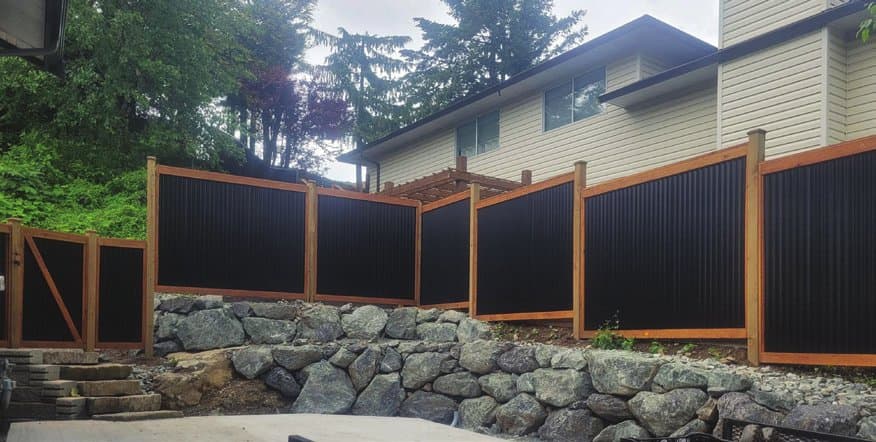
When the brief wants something more deliberate than a wood backyard fence, with a look that reads architectural or industrial rather than residential, the wood-and-steel panel is the one to spec. Black corrugated steel inside a stained wood frame carries a harder line and suits a street-facing commercial elevation, or a developer matching the fence to a building rather than to a garden. It’s the catalogue’s answer to “we want wood, but we don’t want it to look like a backyard.”
The volume side is where commercial and residential really part ways. Commercial runs are long and often phased across a site’s schedule, so what matters is predictable pricing and staged delivery rather than a single drop. Because every panel’s price is published, you can budget a 600-foot perimeter off the same product page a homeowner uses for one side of a yard, with no quote required to build the number. Delivery to site within about 100 kilometres runs $200 for up to 40 panels, and larger jobs can be split into loads that match how the site is being built.
One honest limit, stated up front: we make wood and wood-and-steel panels, not chain-link, not ornamental aluminum, and not welded steel palisade. If the brief is a hard industrial perimeter that has to resist a climb, we’re not the right supplier, and it’s better we say so than be specified into the wrong job. If it’s screening, a boundary, or a finished commercial line in wood, that’s exactly what the catalogue is built for. It’s organized for commercial work on commercial fencing, panel by panel with pricing on /products, and the buying side for trades is on the trade lane.