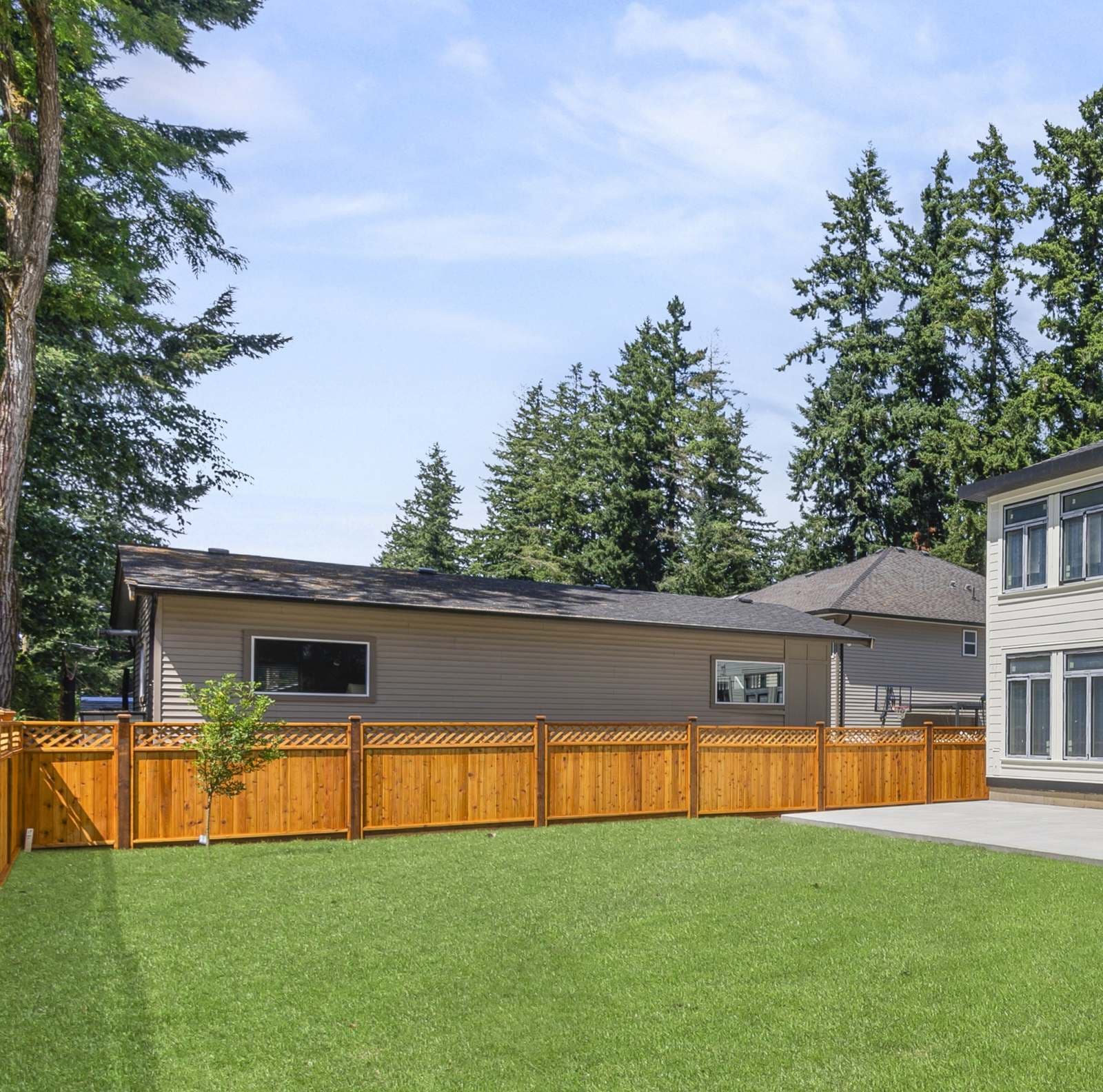
Thirteen panels and fourteen posts. A 100 ft run is 1,200 inches, our panels are 96 inches wide and hang between posts set 96 in. on centre, and 1,200 divided by 96 is 12.5, which rounds up to 13. Twelve full bays cover 96 ft and the thirteenth panel is cut down to fill the last 4 ft. Posts run one more than panels on a straight line: one at each end and one between every pair. That is the whole answer for a straight run. Corners, gates and money take a little longer, so here they are, worked through with the same rules the fence calculator uses.
A straight 100 ft run
Lay out from one end and mark a post centre every 96 inches: 0, 8, 16 and so on to 96 ft, then the end post at 100 ft. That is fourteen posts and thirteen bays, twelve of them 8 ft and one of them 4 ft. Cut the last panel at a rail, not through the lattice, and put the short bay where it shows least, against the house or the garage rather than in the middle of the line. Width is the one number that never moves across our line: every style is 96 in. wide. Standing height does move, from 66.5 to 73.5 in. by style, which matters for a by-law and for meeting a neighbour’s fence but not for the count; the true sizes are in nominal versus true dimensions and on every product page.
An L: 60 ft and 40 ft with one corner
Each leg is laid out from the corner post, and each leg rounds up on its own. The 60 ft leg is seven full bays and a 4 ft bay: 8 panels, and 9 posts counting the corner. The 40 ft leg is five full bays exactly: 5 panels and 5 more posts, because the corner post is already set. Thirteen panels and fourteen posts, the same as the straight run, with one change. The corner post carries two panels pulling in two directions, so it is a 6×6 rather than a 4×4: thirteen 4×4s and one 6×6. In the calculator, type each leg as its own run and mark the corner on one of them (60 ft with one corner, then 40 ft); it counts the post at the corner once and prices it as a 6×6. Drawn on the satellite map, the L is one line with a corner in it, and the count is the same. One caution for legs that both end in a part bay: 65 ft and 35 ft need 9 and 5 panels, fourteen in all, not the thirteen that 100 divided by 8 suggests, because each leg gets its own cut panel. Typed as two runs, the calculator rounds each leg the same way.
The same 100 ft with a 4 ft gate
The gate takes 4 ft out of the panel footage: 96 ft of panels is twelve panels, and no cut. The two posts either side of the gate are 6×6s, because a gate hangs its whole weight off one post and swings against the other. The gate bay has a post on each side like every other bay, so the run sets fourteen posts, twelve 4×4s and two 6×6s, unless one side of the gate hinges off the house itself. The calculator counts it the same way. Ask for the gate when you order: we build gates to match the panel and quote them by hand, so they show on the estimate as a call rather than a price. A single gate is 4 ft wide and a double is 8 ft, and a double takes a full bay out of the count.
What it costs
Divide the panel price by eight for the cost per foot of fence. Good Neighbour Cedar at $104.99 is $13.12 a foot; Heritage Diagonal Lattice at $144.99 is $18.12. Posts are a 10 ft 4×4 at $18.79 and a 10 ft 6×6 at $48.99 ($43.99 each at 25 or more, applied in the cart). Ten feet, not eight, because a 6 ft fence in the GTA sets its posts about 48 inches down to clear frost and needs 6 ft standing above grade; an 8 ft post set that deep is a 4 ft fence. The post-depth note covers the regions where the frost line runs deeper.
The straight run, picked up at the yard. Good Neighbour: thirteen panels $1,364.87, fourteen 4×4 posts $263.06, $1,627.93 before tax, 13% HST $211.63, $1,839.56 all in. Heritage Diagonal Lattice: thirteen panels $1,884.87, the same posts $263.06, $2,147.93 before tax, HST $279.23, $2,427.16 all in. The L swaps one 4×4 for a 6×6, and its posts come to $293.26; the gated run drops a panel and adds a post, two of the fourteen being 6×6s, so its posts come to $323.46. Delivery within about 100 km of Bolton is $200 for up to 40 panels, plus HST, and thirteen panels sit inside the first tier; pickup is free. Posts are pickup only, so a delivered order means a trip to the yard for the posts, or a call for a lumber delivery quote.
Two things the calculator leaves out, because we do not sell them. Concrete: two to three bags per hole, so 28 to 42 bags for fourteen holes, a few hundred dollars at hardware-store prices; check the bag price the week you dig. Hardware: hot-dipped galvanised or stainless fasteners, one box for the whole run. What it does do, in about a minute, is take your run lengths (typed, or drawn on a satellite photo of your lot), the corners, the gates and the style, and itemise panels, posts, delivery and HST at the prices on the product pages, then put the panels in your cart.
When the lumber lands, set the two end posts first, string a line between them at the top rail, and set the twelve between to the string. Let the concrete cure overnight, and the thirteen panels hang the next afternoon.