Product· · Updated ·7 min
Wood fence styles, explained.
Privacy, lattice-top, shadowbox, wood-and-steel: what each style is actually for, and how to pick one without regret.
NorthStar
/Company
Privacy, lattice-top, shadowbox, wood-and-steel: what each style is actually for, and how to pick one without regret.
Every fence conversation starts the same way: someone says “just a normal wood fence,” and it turns out there are five normal wood fences. This is the map: the styles we build as pre-assembled panels in Bolton, what each one is actually for, and the honest trade-offs between them. Pick by what the fence has to do, not by what the last house had.
Solid privacy is the default for a reason. Full-length tongue-and-groove boards, no gaps, no sight lines: a smooth wall of cedar for backyards, property lines and pool surrounds where privacy is the whole assignment. The trade-off is wind: a solid face catches all of it, so posts and footings matter more on exposed runs. Ours is the Solid Privacy Cedar: 1×6 T&G Western Red Cedar on a 2×4 frame.
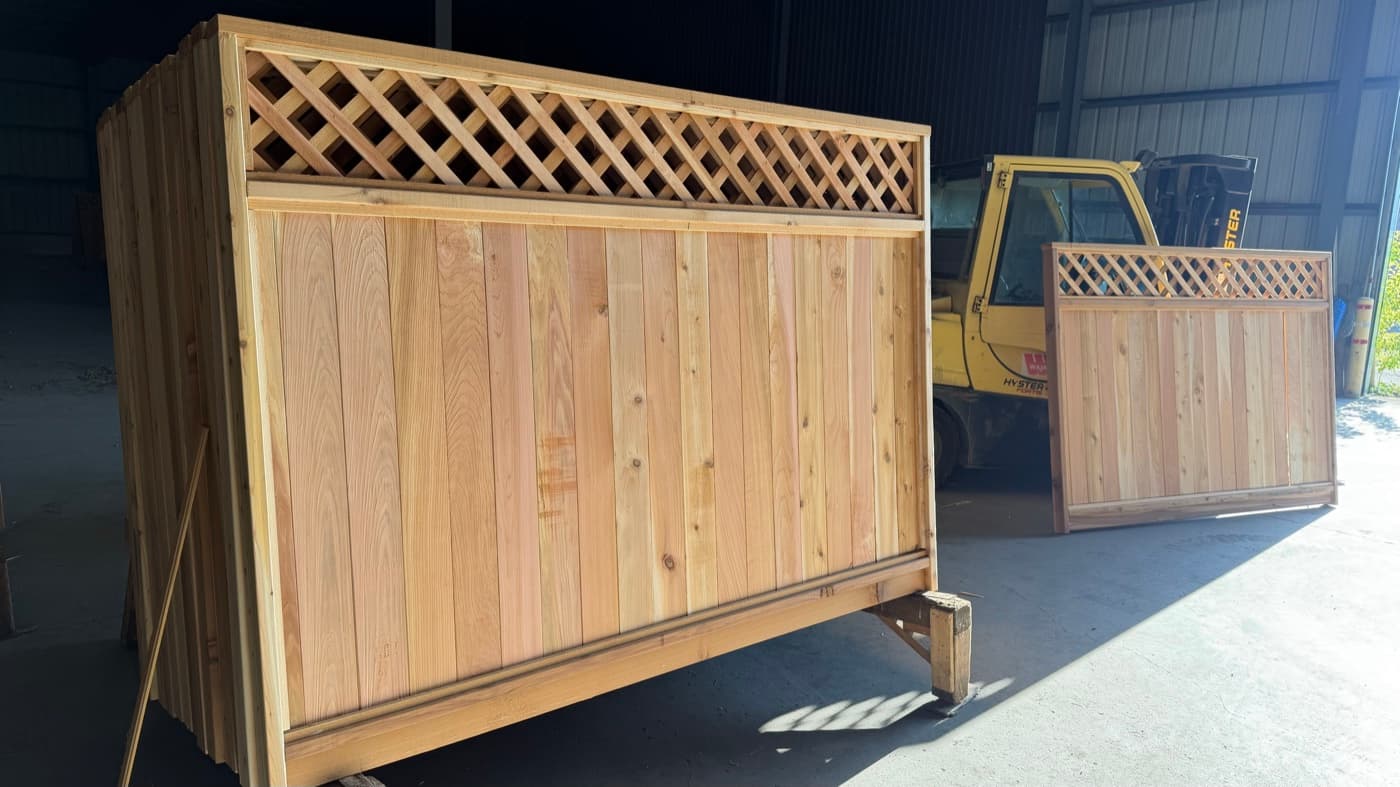
Lattice-top is the classic West Coast profile: a solid base for privacy where you stand, a lattice crown that lets light and air over the top. It reads softer than a full wall, keeps a garden brighter, and takes weight out of the wind equation. The crown comes two ways and the choice is purely visual: diagonal lattice is the traditional look; square lattice reads crisp and modern, especially against black trim. If someone searches “fence topper,” this is usually the fence they end up wanting: the topper is built into the panel rather than perched on an old fence.
We build the diagonal lattice in two specs: the premium panel (1×6 boards on a full 2×4 frame) and the Contractor grade (1×4 boards on a 2×3 frame), the same hand-set lattice look at a price built for volume. If you’re fencing 300 feet and the budget is real, the Contractor panel is the honest workhorse; if the fence is the backdrop to a patio you’ll photograph, buy the premium spec.
Shadowbox, our Good Neighbour, alternates boards on both sides of the rail, so the fence is finished from both faces. It’s the diplomatic choice for shared property lines (nobody gets the “bad side”), the practical choice for windy, open runs (the staggered gaps bleed wind pressure instead of catching it), and it satisfies finished-side-out bylaws automatically. Straight on, it’s private; at a sharp angle there’s a narrow sight line. The full physics are in the shadowbox note.
Wood-and-steel is the modern one: matte-black 26-gauge corrugated steel set in a pre-stained wood frame. Zero-maintenance infill that never rots and never needs staining, with warm wood around it so the yard doesn’t feel like a warehouse. It comes as a full solid face for maximum privacy or with a lattice crown for light over the top. It suits contemporary builds, and it’s the style clients pick when they’ve just replaced a rotted fence and want the next one to outlast them.
Two facts that apply to every style. First, sizes are nominal: “6 × 8” is the trade name, not the tape-measure number. Every product page lists the true dimensions (67.5″ to 73.5″ high depending on style, 96″ wide), and you should lay out your run against those. Second, all of these hang the same way: posts on 96-inch centres, panel between, which is why a style decision never changes the install plan: you can mix a solid run at the pool with shadowbox on the shared line and lattice tops facing the garden, on the same posts, from the same catalogue.
How to choose in one paragraph. For maximum privacy on a calm site, solid. For privacy plus light, diagonal lattice for the classic look or square lattice for a modern one. For a shared line, a windy run or a bylaw that cares, shadowbox. For contemporary architecture or never staining again, wood-and-steel. For a long run on a budget, Contractor grade. Every panel and every price is published at /products, built in Bolton, and available for pickup or GTA delivery, and if you’re still torn, send us the yard and we’ll tell you what we’d put there.