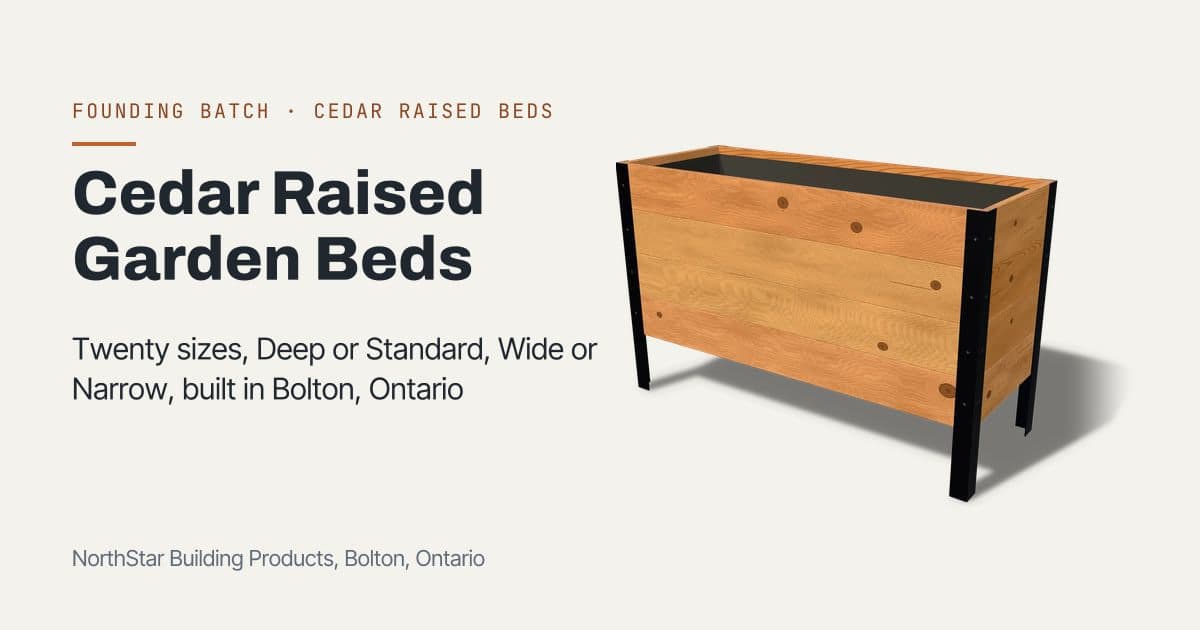
For food, untreated cedar, and the rest of this post is the case for that answer and the two places it is wrong. Pressure-treated pine builds the cheapest box and lasts, but it puts a copper preservative against your soil and the organic standard will not allow it. Galvanized steel never rots and looks the part, but the walls are thin, they run hot in July, and most kits sit on the ground rather than on legs. Cedar costs more than either and greys in a year; in exchange nothing sits between the wood and the soil, and the box is the lightest of the three to move.
What each material puts in the soil
Cedar, untreated, puts cedar in the soil: the wood's own extractives, the thujaplicins and lignans that make it resist rot, and nothing added. That is the whole of the food-safety case and it is why we do not stain, seal or treat the inside of a box.
Pressure-treated pine is a different conversation. Since the end of 2003 the residential treated lumber sold in Canada has been treated with copper-based preservatives, alkaline copper quaternary or copper azole, after chromated copper arsenate was phased out of residential use. Copper is a fungicide, and it leaches from treated wood into the adjacent soil in small amounts. Health Canada's Pest Management Regulatory Agency registers these preservatives for residential use, so this is not a hazard warning; it is a fact about what touches the soil. Canada's organic standard, CAN/CGSB-32.310, does not permit lumber treated with prohibited preservatives in new installations in contact with soil or livestock. If you would not be allowed to sell the tomatoes as organic, that is a reasonable line to draw for your own.
Galvanized steel is sheet steel with a zinc coating, and the zinc is what the soil touches and what the soil slowly consumes. Zinc is a plant micronutrient at the levels involved, and there is no serious food-safety argument against a steel bed. The argument is about the coating's life and about heat, below.
How long each one lasts
Cedar first, because it is the one with published numbers. The USDA Wood Handbook's durability tables put Western Red Cedar heartwood in the resistant class, and the service-life ranges published for that class run 15 to 30 years above ground and 5 to 15 in ground contact. A lined, elevated bed sits between them, and the long version of that answer is its own post.
Treated lumber in Canada is treated to a use category under the CSA O80 standard, above-ground or ground-contact, and treaters back residential lumber with limited warranties that commonly run for decades. In a lined, elevated bed it lasts as long as cedar or longer. The two conditions are the cut ends, which expose untreated wood and need a brushed-on preservative, and the fasteners, which must be hot-dipped galvanized or stainless because the copper in the treatment corrodes plain and electroplated steel and stains the wood around it.
Galvanized sheet lasts as long as its zinc. Zinc corrodes slowest in dry air and fastest at a wet soil line, and the American Galvanizers Association's corrosion data put wet, acidic soil at the short end of the coating's life. Kit makers therefore publish a warranty rather than a rated life, and a scratch through the coating rusts from the edge inward. The sheet behind the zinc is thin, so once the coating is gone there is not much steel to lose.
Heat, weight and handling
A 3/4 inch cedar board insulates; a steel wall conducts. On a July afternoon the soil against the wall of a steel bed runs hotter and dries faster than the soil behind a cedar board, and roots avoid the hot edge, which costs you the outer few inches of the bed in the weeks that matter most. It cuts the other way in May, when a steel bed warms a little sooner. On weight, Western Red Cedar is one of the lightest softwoods in the Wood Handbook's tables, about 23 lb per cubic foot dry, where the pines and spruces sold as treated lumber run a third to a half heavier and arrive wet from the treatment cylinder on top of it. Steel panels are light, but they come with many screws, edges that want capping, and, for an elevated bed, a frame that has to be bought or built separately. Cedar cuts, drills and takes a bolt with ordinary tools.
The liner, whichever you choose
Whatever the wall is made of, put a fabric liner between it and the soil. In a cedar bed it keeps the boards drying between waterings, and it is most of the difference between the low and the high end of the service-life range. In a treated bed it is the only thing between the preservative and the roots; it does not stop copper leaching, it slows soil contact, and it is the least you should do if you build one. In a steel bed it keeps wet soil off the zinc at the soil line, which is where the coating goes first. Landscape fabric works. A waterproof membrane does not, because a bed has to drain, and a bed that cannot drain rots its wood, corrodes its steel and drowns its plants in the same wet week. Ours ships with the liner in the carton, cut for the size, and the assembly page shows where it goes.
What each one costs
Cost is where pressure-treated wins and it is not close: the boards for a ground-level treated bed cost less than any elevated bed, ours included. Steel kits vary with the gauge and the coating, and the elevated versions cost more than the ground ones. Ours: a Wide 48 Deep cedar bed at working height on steel legs is $176.99 in Knotty at the founding price with shipping across Canada included; the smallest Narrow Standard bed is $129.00 and planter boxes start at $158.99. That is the price of the material and the height together, and every size page shows where the money goes, line by line, including the courier.
Where cedar is the wrong answer
Two places. The first is a ground-level bed on a budget, at a rental or an allotment, where a treated frame with a liner does the job for the least money and the soil never has to be moved. The second is a permanent, in-ground retaining edge in wet clay, because ground contact is where cedar's number drops to 5 to 15 years and treated ground-contact lumber is rated for exactly that. In both cases the honest advice is treated wood with a liner, or steel, and we say so on the fence side of the site as well.
The combination most gardens end up with
Treated posts under cedar boards is the standard fence in Ontario for a reason, and beds follow the same logic: the part in the ground is treated or steel, the part that holds the food is cedar. Our beds take that to its end. The legs are steel, the ground never touches wood, and the soil never touches anything but cedar and a fabric liner. The three materials are set side by side, with their sources, on the compare page, and the beds and boxes themselves start at the Founding Batch.