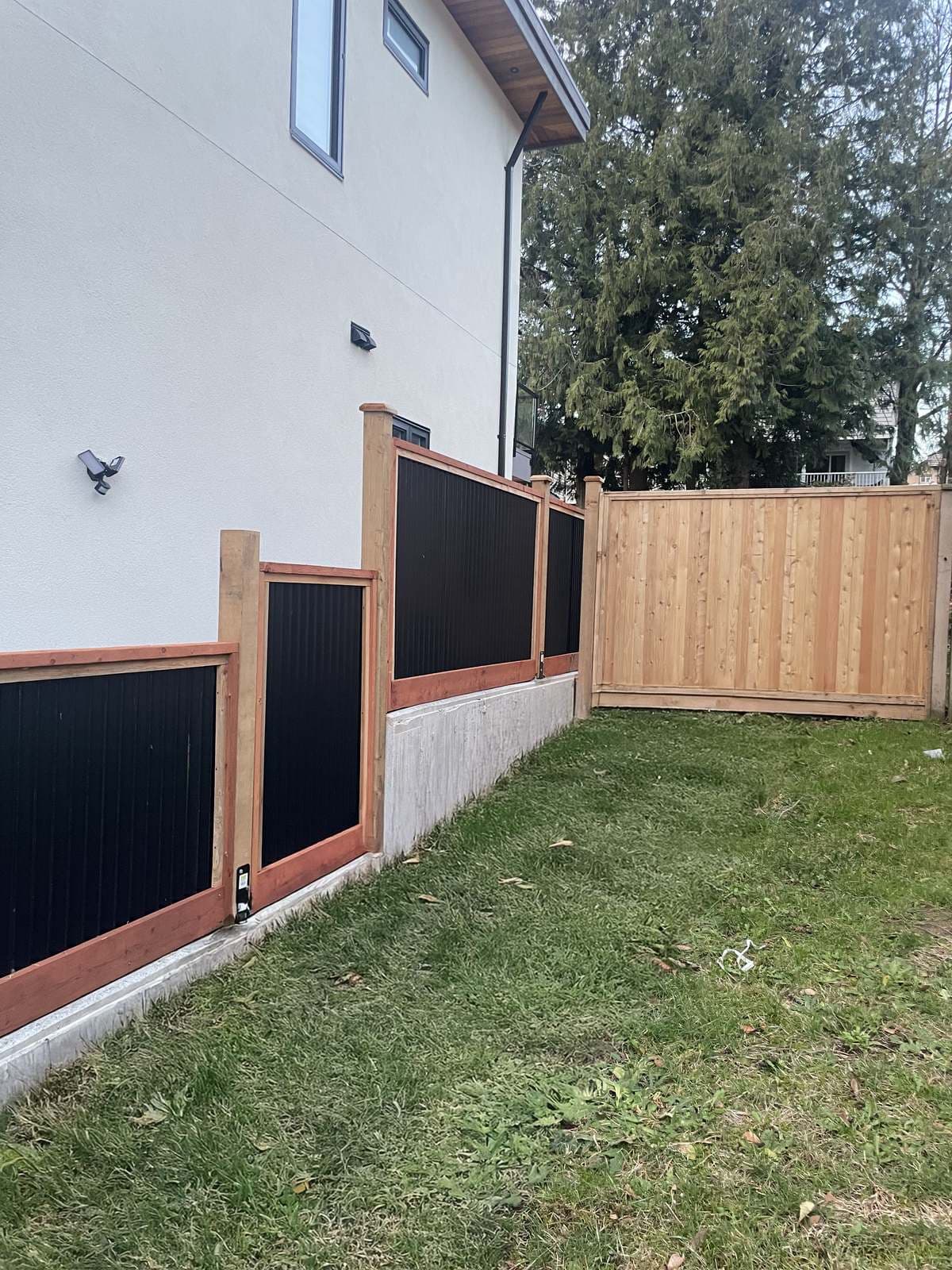
Steel if you never want to stain a fence face again, cedar if the fence is on show, pressure-treated if the budget leads, and vinyl if you want a white or grey fence with no wood in it and can live with what deep cold does to plastic. That is the short version. We build the first three as pre-assembled 6 × 8 panels in Bolton and we do not sell vinyl, so read the vinyl column knowing where we sit. The rest is what twenty Ontario winters do to each material, and the price per foot of ours set side by side.
What each one is
A corrugated metal fence panel, in the form most Ontario yards want, is a sheet of 26-gauge black steel set in a wood frame. Ours is a pre-stained 2×4 frame around a solid steel face or a face with a diagonal lattice top, at $169.99 each. All-steel systems with steel posts and frames exist too, mostly sold from BC by freight, and read more industrial. A cedar panel is Western Red Cedar boards on a cedar frame: five styles from $104.99 to $159.99. A pressure-treated panel is brown-treated pine, solid or shadowbox with a lattice crown, at $144.99 and $149.99. A vinyl panel is hollow PVC boards in PVC rails, usually white, grey or tan, sold as a system with its own posts and caps.
Privacy and sight lines
Solid steel and solid boards give the same thing: no sight line from any angle. Lattice tops on either material trade the top foot for light. Shadowbox, which we build in cedar and in treated, is semi-privacy: private straight on, a narrow sight line at a sharp angle. Vinyl privacy panels are solid and stay solid, because the boards lock together; the same joints are why a cracked vinyl board is a section replacement rather than a board swap.
Wind, cold and snow
A solid face is a sail whatever it is made of, and the wind loads the posts, not the panel, so the posts decide the fence: 48 in. deep across most of southern Ontario, gravel and concrete, a 6×6 at gates and corners. Steel adds nothing to that problem and takes nothing away. A sheet framed on all four sides does not flex, drum or work its fasteners loose the way an unframed sheet screwed to posts can, which is where the stories about noisy metal fences come from. Cold is where the materials part. Steel and wood do not care about minus 25. PVC does: vinyl goes stiff and brittle in deep cold, and the snow shovel, the plough spray and the falling branch that bounce off a steel face or dent a cedar board can crack a vinyl rail, with the repair waiting for spring and for the maker's parts. Snow piled against any fence should be pulled back before it freezes into a load on the bottom rail; on our steel panel the wood frame carries that load, as on any panel.
Maintenance, and how each one ages
The steel face: hose it off, touch up a scratch that reaches metal, and expect the factory finish to outlast the frame around it; the manufacturer's limited 40-year warranty covers the steel and that finish. The frame is stained wood, not cedar, and wants a coat on a many-years cycle, which is the honest part of "maintenance-free" that a wood-framed panel has to say out loud. Cedar needs nothing for durability and greys to silver in about eighteen months; stain it if you want the amber, every two to three years. Treated pine is brown from the treatment and holds it for years, then checks and greys unevenly. Vinyl needs no stain and cannot take one, which cuts both ways: no weekend with a brush, and no way to refresh a face that has chalked or picked up green on the north side beyond washing it. We have not watched Ontario vinyl at twenty years ourselves, so ask a neighbour with an old run rather than a brochure.
Repairs
A cedar or treated panel that takes a hit loses a board, and a board is a trip to the yard. A steel panel that takes a hit worse than a dent is a panel, and ours is a panel from Bolton this week at the published price, hung on the same posts. A vinyl section is a section from whoever made it, in the profile and colour they made it in, and vinyl systems change more often than lumber does. The frame side matters too: our frame is standard 2×4 lumber, so a rail can be replaced from any yard, where an all-steel frame is a part number from one factory.
Heat, noise and looks
A black steel face gets hot in full afternoon sun, the way a black car does, and a thin sheet cools within minutes of shade. Wood and vinyl stay cooler, and white vinyl reflects enough to glare. A framed steel panel is quiet in wind; heavy rain is audible up close on any hard surface. On looks, the metal panel is the modern one and suits black windows and flat roofs; cedar is the traditional one and ages the most gracefully; treated is the working one; vinyl is the uniform one, the same on the day it goes up and the day it comes down.
Price per foot
Ours, from the price list on 2026-09-28, all 8 ft wide, so divide the panel by eight: Good Neighbour Cedar $13.12 a foot, contractor-grade Heritage Diagonal Lattice $11.87, Pressure-Treated Privacy $18.12, Solid Privacy Cedar $20.00, Wood & Steel $21.25. Add $2.35 a foot for a 10 ft 4×4 post per bay. We do not sell vinyl and have not benchmarked it, so there is no vinyl number here; get a dated quote for a 6 ft privacy panel with its posts and caps and set it against the figures above. Posts, concrete and labour underneath all four are the same money, which is most of an installed fence, and the metal cost post works a 100 ft run through with HST.
Which one, then
Steel for a street-facing or modern build, for the owner who has just replaced a rotted fence and wants the next one to outlast them, and for anywhere staining is never going to happen. Cedar for the fence you look at from the kitchen, the pool surround and the front yard. Treated for the long back run, the rental and the perimeter where footage beats finish. Vinyl for the white picket look with no wood, in a yard sheltered from plough spray and falling limbs. Most yards mix: steel on the street side, cedar or treated on the shared lines, and because all three of ours hang between posts at 96 in. on centre, that is one layout, not three. Stand a steel panel next to a cedar one at 240 Ellwood Drive West before you decide; the whole line is on the Wood & Steel page and the comparison table.