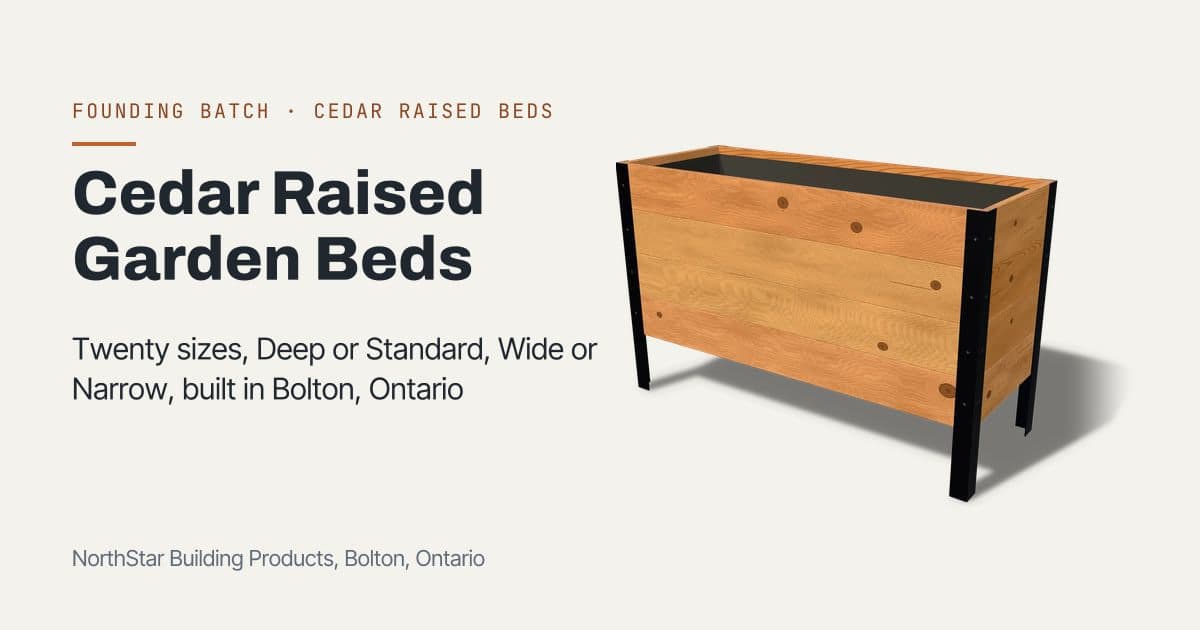
Fifteen to thirty years above ground for untreated Western Red Cedar, five to fifteen in contact with the ground. Those are the published service-life ranges for the decay-resistance class the USDA Wood Handbook puts cedar in, and a raised bed on legs holding wet soil sits between them. Expect the low half of the above-ground range if the bed is unlined and left saturated, and the high half if it is lined, drains and dries out over winter. That is the whole answer. The rest of this post is where the numbers come from, what moves a bed toward one end of the range or the other, and why the elevated cedar beds we build in Bolton print the range instead of a bigger number.
Where the numbers come from
The USDA Forest Service's Wood Handbook, the reference every wood engineer in North America keeps on the shelf, sorts the common species by the natural decay resistance of their heartwood. Western Red Cedar is in the resistant class with white oak, redwood and black locust; the pines, spruces and firs are in the non-resistant class, which is why they are pressure-treated before they go outside. The European durability standard, EN 350, does the same job on a five-point scale and puts Western Red Cedar in class 2, durable. Neither table gives a number of years, because years depend on the job. The 15 to 30 above ground and 5 to 15 in ground contact are the service-life ranges published for that class by the wood trade, and they are the ranges we use on the size pages and in the FAQ, with the caveats that follow.
What makes cedar resist rot
The resistance is in the wood, not on it. Western Red Cedar heartwood carries extractives, thujaplicins and related tropolones, lignans and terpenes, that the fungi which rot wood cannot digest and mostly avoid. They are why a cedar fence post from the 1970s can still be sound at the top, and why the wood smells the way it does when it is cut. Two things follow. First, the sapwood, the pale outer band of the tree, carries little of it and rots like any softwood, so how much sapwood a board carries matters more to a bed's life than whether the board is Clear or Knotty, and it is the first question to ask of any cedar. Second, the extractives are in the wood all the way through, so a cut end or a drilled hole exposes more of the same wood rather than an untreated core. That is the difference from pressure-treated pine, where the preservative sits in the outer part of the board and every cut end is supposed to be brushed with more of it.
What shortens a bed's life
Wood rots when it stays wet and warm with air on it. A raised bed is a box of wet soil, so the question is how wet the boards stay and for how long. Four things push a bed toward the low end of the range. Soil in direct, constant contact with the wood, which keeps the inside face at the moisture content fungi want for the whole season. No drainage, so the bottom boards sit in water after every rain. Ground contact, which adds the soil organisms and keeps the base from ever drying; the 5 to 15 year figure is the ground-contact figure for a reason. And a bed that goes into winter saturated and freezes that way, which opens checks in the boards that hold more water the next year.
What lengthens it
The same list in reverse, and it is most of what an elevated bed is. A fabric liner over the planks and up the walls keeps the soil off the wood; the boards still get damp, but they dry between waterings instead of staying wet. Base planks with drainage gaps of 3/8 to 1/2 inch let every watering leave. Legs put air under the box, and air is what dries wood: the base of an elevated bed lives nothing like the base of a ground bed. Stopping watering in late fall lets the soil dry down before it freezes. And a board 3/4 of an inch thick has more to give than the thinner stock in many kits, because a board loses strength in proportion to what the rot has eaten. Oil on the outside faces holds the colour and slows surface checking; it does not change the rot arithmetic much, and the inside of the box should stay bare. The assembly page puts the liner and the planks in the order you fit them.
Why we print the range
You will see bigger numbers on other sites. We looked for a source for them and did not find one that applies to wood holding wet soil; the service-life tables are the best evidence there is, and they say 15 to 30 years above ground with the bed's design deciding where in that range you land. A fence panel, which the same cedar builds, has an easier life than a planter. It is vertical, it sheds water and it dries on both faces every afternoon, which is why our fence pages say 25 to 40 years on properly set posts. A bed is a harder job for the same board, and we would rather say so than sell you the fence number.
Clear or Knotty makes no difference here
Knots are where branches grew; a sound, tight knot is denser than the board around it and carries the same extractives. The small checks that open beside a knot as the board dries are surface marks, not paths into the board. Loose and dead knots are culled at the saw because they can drop out and leave a hole, and that is the only way a knot affects a bed's life. Clear costs more because clear boards are scarcer, not because they last longer; the difference between the two grades on any size is printed beside the price.
The steel and the hardware
The legs are L-shaped steel angle brackets that wrap the outside of each corner and run to the ground, powder-coated black. Powder coat is a baked finish applied with no solvent, and it lasts as long as nothing scratches through it; a scratch touched up with any exterior enamel stops there. The carriage bolts run through the legs and the boards and are the only metal the wood touches. Cedar's extractives are mildly acidic and will streak around bare steel over the years, which is a reason to keep the coating on the legs intact and to check the nuts with the wrench once a year after the first winter, when the boards have done most of their moving.
What lasting looks like
A cedar bed does not fail on a date. In year one it greys. From year two to year ten nothing happens that you would notice. Somewhere in the second decade the inside face of a bottom board softens where the soil sat wettest, and because the box is bolted rather than nailed, that board comes off and a new one goes on for the price of a 1x6 while the rest of the bed carries on. The legs outlast the wood. So when you read the range on the Wide 48 Deep page or any other size, read it as the life of the box before its first board needs replacing, not the day it goes to the curb.
Our warranty
The warranty is 3 years from delivery on the structure and the steel legs, the same for Clear and Knotty: a board that splits through, a joint that opens or a leg that fails in normal garden use is replaced at our cost, part or unit, and anything damaged in transit is replaced the same way with nothing to ship back. Greying, checks and knots are the material and not defects, and a bed left standing in water is outside the term. The term is printed on every size page and in your confirmation email, so the term you see when you order is the term you have, and the phone number on every page reaches the shop that built the bed. The rest of the questions about the wood are answered on the planter FAQ, the cedar-against-treated-against-steel comparison is on the compare page, and the line itself starts at the Founding Batch.