Dispatch· · Updated ·6 min
Pre-assembled fence panels: factory-direct versus big-box.
Home Depot sells fence panels. So do we. Here’s the like-for-like comparison a spec sheet would give you.
NorthStar
/Company
Home Depot sells fence panels. So do we. Here’s the like-for-like comparison a spec sheet would give you.
If you search “premade fence panels” or “pre-assembled fence sections” in the GTA, you get two kinds of results: the big-box aisle (Home Depot, Lowe’s, the lumber-yard chains), and manufacturers like us. Both sell a 6×8 wood panel. They are not the same product wearing different prices, and the differences are checkable, so here’s the honest comparison.
Start with what a big-box panel is. It’s built for a national supply chain: assembled by the thousand, shipped flat through distribution centres, and priced to win the shelf. That drives the spec: boards commonly ⅝-inch or thinner so more panels fit a truck, stapled to the frame because staples are fast, species and grade chosen by cost that quarter. None of this is a scandal; it’s what mass retail is for. But a fence panel is a structure that lives outside in Ontario weather for twenty years, and the spec decides how it ages.
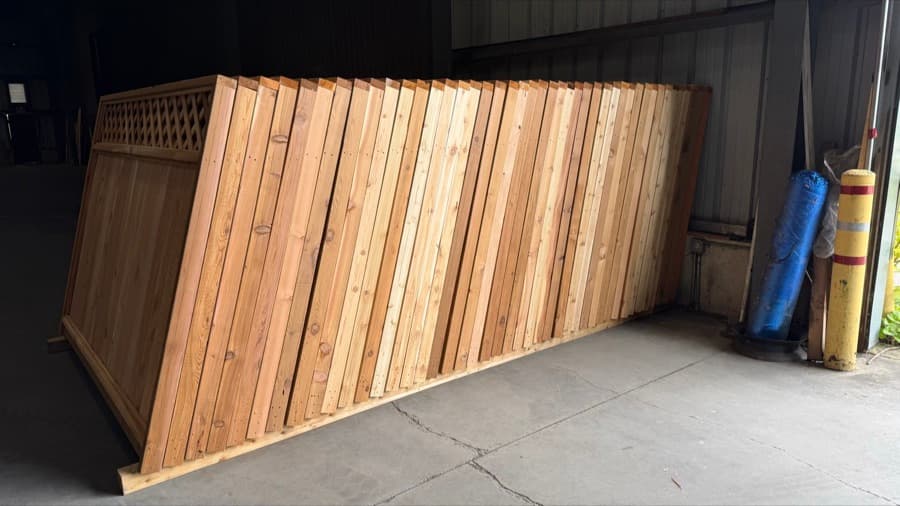
Now the factory-direct version. Our panels are assembled in a jig in Bolton: full-dimension Western Red Cedar boards (1×6 tongue-and-groove on the privacy panel, 1×4 on the shadowbox) on 2×4 or 2×3 frames, fastened on a schedule the jig enforces, the same on panel one and panel five hundred. The spec is published on every product page down to the true tape-measure dimensions, and the price is printed next to it. You can drive to the yard and stand a panel up before you buy forty.
The price comparison people actually make is misleading, and it’s worth naming. The $60–90 panel at the big box is almost always thin pressure-treated pine; ours run $94.99 to $169.99, in Western Red Cedar, premium brown pressure-treated and wood-and-steel. That comparison mixes species and grades as well as stores. Compare like for like, big-box cedar or premium lattice panels against ours, and the gap narrows to nearly nothing, at which point the differences that remain are board thickness, frame spec, who assembled it, and whether anyone will answer the phone afterwards.
Logistics differ more than people expect. Big-box: you pick from the stack that’s left (check each panel for shipping cracks and staple blow-through, because flat-packed panels travel hard), strap eight-foot sections to something, and haul them yourself. Factory-direct: order online at the published price, and panels are staged banded and flat for pickup in Bolton, or delivered across the GTA for $200 per 40 panels. For a contractor doing a 300-foot run, that difference is a crew-day.
To be fair to the aisle: the big box wins in two scenarios. If one panel blew down and you need a same-day patch while the rest of the fence lives out its last years, the nearest orange or blue store is the right answer. And if the entire project is priced to the last dollar on a rental, their treated line is the budget floor. Our Contractor-grade cedar panel at $94.99 is our answer to that job, but a floor is a floor.
For everything else, whether it’s a fence you’ll look at for two decades, a run long enough that consistency shows, or a job where the installer’s time costs more than the panels, buy the panel from the people who built it. The catalogue, with published prices and true dimensions, is at /products; the math on labour is in prefab versus stick-built; and if you’re pricing a whole project, here’s where the money actually goes.