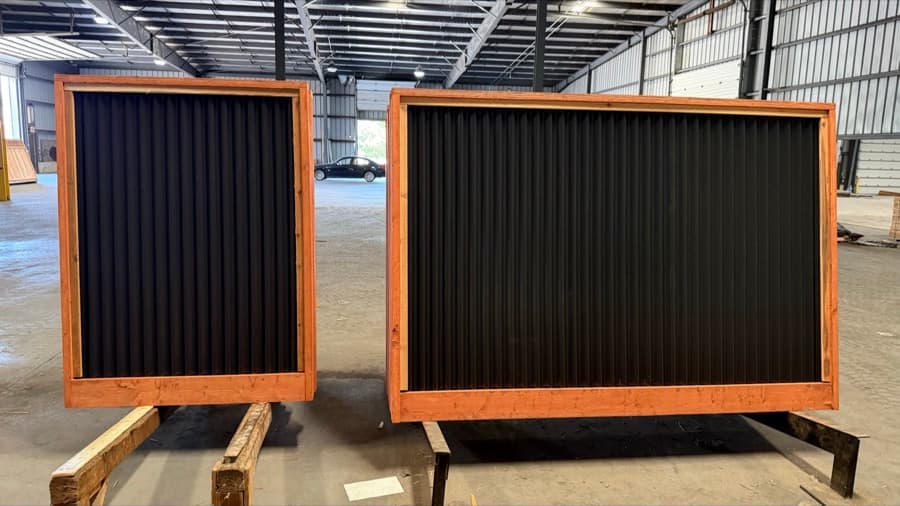
One size. The Wood & Steel panel is 6 × 8 nominal and a true 66.5 in. tall by 96 in. wide; the lattice top is a true 68 in. by 96 in. Both hang between posts at 96 in. on centre, so a run is laid out in 8 ft bays, and almost every run ends in a bay that is not 8 ft. On a cedar or treated panel that last bay is a cut at the rail on site. On a metal panel it is not, because we do not cut the steel in the field, so the odd bay is a custom-width panel from the shop, a wood panel where it shows least, or a layout that makes the odd bay disappear.
96 in. on centre, not 96 in. between posts
The number that matters is the post spacing, not the panel width. Mark post centres every 96 in. along the run; the frame uprights land on the post faces and take the fasteners, through wood into wood, and a bay set at 93 in. will not take the panel while one at 99 in. leaves it hanging on its screws. The spacing is the same with a 4×4 or a 6×6, so a gate or corner post does not change the layout. It is the same layout as every panel we build, which is what lets a metal run share posts with cedar; the install post has the string line and the depths.
True heights, and what stands above grade
"6×8" is the trade name and 66.5 in. is the tape measure; the lattice top stands 68 in., and nominal versus true explains why. A 10 ft post with 48 in. in the ground stands 72 in. above grade, the panel sits on 3/16 in. spacers, and the few inches of post above the panel are where the cap goes. Where a metal panel meets a wood one the tops differ by an inch or two, since the cedar and treated panels stand 67.5 to 73.5 in.; decide which top the eye follows and step the other to it. Every town writes its own height rule, so read your town's page before you buy for a front yard or a pool.
Measuring the run and finding the odd bay
Measure the run in inches from the centre of the first post to the centre of the last, divide by 96, and the whole number is the count of full bays; the remainder is the odd bay. A 100 ft run is 1,200 in.: twelve full bays and 48 in. over. A 45 ft run is 540 in.: five bays and 60 in. The remainder goes where it shows least, usually against the house, at the back corner or at the gate. The 100 ft post works the count for an L and a gated run.
Why we do not cut the steel in the field
A field cut through corrugated steel leaves a bare edge at the surface, out in the rain, and a bare edge is where rust starts and where the manufacturer's finish warranty is written to stop. On a cedar panel the cut runs through boards and a rail, and the remaining rail end takes the fasteners, which is why a wood panel can be cut down on site and a framed steel panel cannot. Every sheet of steel has edges; on our panel they sit behind the frame, out of the weather, with the frame built around the sheet in a jig. That is the difference between a shop cut and a yard cut.
Option one: a custom-width panel from the shop
Tell us the bay and we build the panel to it: the same steel, the same pre-stained frame, the same jig, at the width the remainder needs. It is quoted by hand and built alongside the run so it arrives with the rest. Custom heights are built the same way, for a front-yard run or a step-down. Ask when you order; the standard panels are on the yard the next business day and the custom one is not.
Option two: a wood panel at the odd bay
A Good Neighbour Cedar panel at $104.99 or a Pressure-Treated Privacy panel at $144.99 cuts down at the rail on site like any wood panel and finishes the run at the odd bay with no lead time. Put it where it shows least; the top will sit an inch or two off the steel's. If the whole shared line is cedar and only the street side is steel, this is not an odd bay at all, just the place where the materials change.
Option three: make the odd bay disappear
A 48 in. remainder is a gate opening. Put a 4 ft single gate there, on two 6×6 posts, and the run is full bays plus a gate, which is the layout of the gated run in the cost post. A short remainder can sometimes be absorbed by moving the first post a few inches off the house wall, or by ending a bay short and turning the corner. A remainder that is nearly a full bay is usually better as one more full panel with the last post at the property line. The gates post covers the gate.
Mixing with cedar for a step-down
The common GTA layout is steel on the street side or the back line and cedar on the shared lines, on one set of posts. A step-down from a full-height steel run to a lower front-yard run is the same idea in height: the lattice top at 68 in. makes the transition between a solid steel run and a cedar lattice panel, since the crowns match. On a slope every bay is level and the next drops by the grade over 8 ft, with the post cut to the lower panel's top; a framed steel panel cannot be racked to follow the ground, so a steep lot is a stepped fence and reads as one.
Put the run into the fence calculator, which counts the full bays and the posts at the same prices as the cart, and tell us the remainder when you order. Both panels stand at 240 Ellwood Drive West in Bolton, and the line is on the Wood & Steel page.