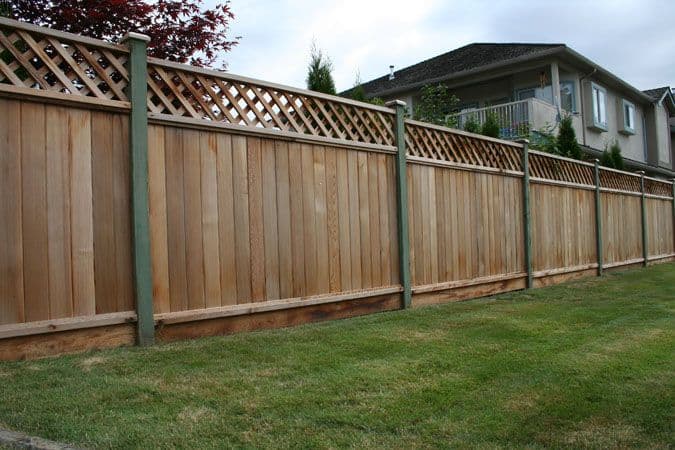
A lattice top fence panel is a solid fence for most of its height with an open lattice across the top: boards fastened tight to the rails to about five feet, then a foot or so of criss-crossed lattice in its own frame above them. You get privacy where people stand and look, and light, air and a finished top line where a solid wall would loom. We build five at 240 Ellwood Drive West in Bolton, all 6 ft × 8 ft nominal and 96 in. wide: the Heritage Diagonal Lattice in Western Red Cedar at $144.99, the same panel in a contractor grade at $94.99, the Heritage Square Lattice at $144.99, the Pressure-Treated Lattice Top at $149.99, and the Wood & Steel Lattice Top at $169.99. Here is what the lattice does, how diagonal differs from square, and how to pick the wood.
What the lattice is for
Three things. Privacy at eye level: the solid boards run higher than the sight line from a patio chair or a kitchen window, so the yard is private where it matters. Light and air: a 6 ft solid wall on a small lot shades the beds along it and turns a breeze into a load on the posts, and the lattice lets both through the top foot. And the top line: a lattice crown reads as a finished edge, the way a cap rail does on a deck, so a long run looks designed rather than stockaded. What it does not do is stop a view from an upstairs window, which no 6 ft fence does. If zero sight lines from any angle is the brief, a pool surround for example, the solid privacy panels are the answer.
Diagonal or square
The base is the same; the crown is the choice. Diagonal lattice is the classic West Coast pattern, the one most people picture when they say lattice top, and on our cedar panels it is hand-set in its frame. Square lattice is a straight grid, quieter and more geometric, and it suits a modern house, black window frames and a straight-line garden. Neither is more private than the other, and both take the same posts, so the decision is about the house behind the fence. The cedar diagonal comes in two grades: the premium panel is 1×6 boards on a 2×4 frame, and the contractor grade is 1×4 boards on a 2×3 frame with the same hand-set lattice, $50.00 less a panel and the same look from the sidewalk. Nominal versus true explains why both stand 69 in. rather than 72.
Cedar, treated wood or steel
Three materials, and the base under the lattice is not the same in each. The three cedar panels have a solid face of Western Red Cedar under the crown: private below, open above, no stain needed, silver-grey in a season or two unless you oil it. The Pressure-Treated Lattice Top has a shadowbox base, boards alternating on both sides of the rails, so it is finished from both yards and semi-private rather than solid, with a narrow sight line at a sharp angle and the same diagonal crown on top; it is the good neighbour pattern in brown treated wood, a true 72 in. tall, with the brown in the treatment rather than brushed on. The Wood & Steel Lattice Top sets 26-gauge black corrugated steel in a pre-stained wood frame under a diagonal lattice, a true 68 in.; the BC online sellers offer their corrugated panels with a solid face only. Cedar versus pressure-treated has the long version of the wood question.
Heights, by-laws and the neighbour's fence
Our lattice-top panels stand 68 in. to 72 in. by material, and a town measures a fence to its highest point, so the crown counts. Most GTA towns allow about 6 ft in a back yard and less in a front yard, each with its own definition of where the yard starts, and the by-law pages quote the rule for each town with the section it came from. Where the run meets a neighbour's existing fence, decide which top line the eye should follow: a 69 in. cedar lattice top on 3/16 in. spacers stands within an inch or two of most 6 ft panels, and the post caps take up the rest. The Heritage panels also come in 4 ft and 5 ft heights for a front yard or a step-down, and gates are built to match.
Mixing lattice and solid on one run
Every panel we build is 96 in. wide and hangs on the same posts, so a run can change style at any post without changing the layout. The common mix is lattice along the patio and the side yard, where light matters, and a solid face along the back line or around a pool, where sight lines do. A diagonal cedar lattice next to the Pressure-Treated Lattice Top keeps one crown across two woods, which is how a budget back line and a cedar street side meet without a seam. On a slope, each bay is level and the next steps down by the grade over 8 ft; the lattice is what makes a stepped fence read as one line, because the eye follows the crown.
Installing, and the one thing to know about cutting
A lattice-top panel hangs like any other: posts at 96 in. on centre, 48 in. in the ground for a 6 ft fence, the panel on 3/16 in. spacers off the ground, fastened through the frame uprights into the post faces. The lattice is the delicate part of the panel, so carry it by the frame and never by the crown. The last bay of most runs is short, and a wood panel can be cut down on site: cut through the rails and the lattice frame at the width you need, then fasten a new upright to the cut end so the lattice keeps a frame on all four sides before the panel goes on the posts. The installation guide has the steps and the string line; the 100 ft post works the count.
What a lattice top costs
Divide by eight for the foot. The cedar diagonal is $18.12 a foot and the contractor grade $11.87, the square $18.12, the treated lattice top $18.75 and the steel $21.25, before posts, concrete and HST. A lattice top is not the expensive option: the cedar diagonal is $15.00 less than the solid privacy cedar panel, because a foot of lattice replaces a foot of tongue-and-groove board. On 28 September 2026 the big box listed its closest 6x8 cedar diagonal lattice panel at $208.00, out of stock at the stores we checked; ours was $144.99 on the yard. Every figure with its date is on the price list.
Put the run into the fence calculator with the style you are leaning to, and stand in front of all five at 240 Ellwood Drive West before you decide; the diagonal and the square look different in person than in a photo. The cedar line is on the cedar page, the treated panel on the pressure-treated page, and the steel on the Wood & Steel page.