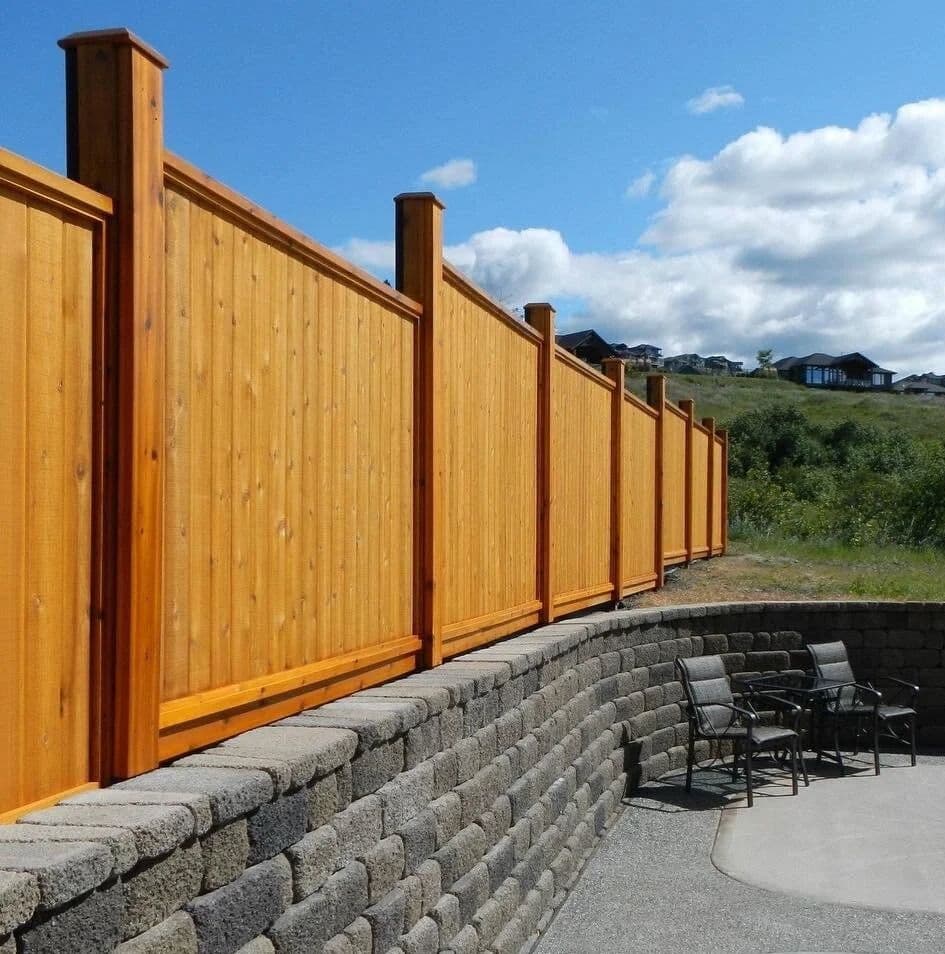
A privacy fence panel has a solid face from rail to rail: no gaps between the boards, no view through from any angle, standing or crouching. We build three at 240 Ellwood Drive West in Bolton, all 6 ft × 8 ft nominal and 96 in. wide: the Solid Privacy Cedar at $159.99, tongue-and-groove Western Red Cedar on a 2×4 frame, a true 67.5 in. tall; the Pressure-Treated Privacy at $144.99, solid vertical brown boards on a heavy frame, a true 73.5 in.; and the Wood & Steel at $169.99, a sheet of black corrugated steel in a pre-stained wood frame, a true 66.5 in.. Here is what separates a privacy panel from a fence that merely looks solid on the day it goes up, how the three differ, and when a shadowbox is the better buy.
What no sight lines means
Most wood fences that look solid on day one are boards butted edge to edge, and wood shrinks across its width as it dries. A wet board that goes up tight opens a gap by August, and a fence of them is a fence of slots. The Solid Privacy Cedar is tongue-and-groove: each board's tongue sits in the next board's groove, so the boards can move with the seasons and the joint stays closed. The Pressure-Treated Privacy is solid vertical boards from kiln-dried stock, most of the water already out before the boards were fastened, which is what keeps the joints tight; it is the same premium brown treated wood we sell by the piece. The steel panel has nothing to shrink: one sheet, fastened flat in a jig inside its frame. All three are private from any angle at any height a person stands, which is the whole definition, and none of them stop a view from a second-floor window, which no 6 ft fence does.
Cedar, treated or steel
Pick by what the fence is for. Cedar for the run everybody sees: it needs no stain to last, weathers to silver-grey or holds its amber under an oil, and moves about half as much as pine through a year of Ontario weather, which keeps a panel square. Brown treated for the working run, a back line or a rental property, where the budget matters more than the species; the colour is in the treatment, so it goes up finished, and it is $15.00 less a panel than the cedar. Steel for a modern house and the least upkeep: the steel wants a hose and carries its manufacturer's limited 40-year warranty on the steel and its finish, and the frame is stained wood that wants a coat every few years. Cedar versus pressure-treated has the long version, and metal versus vinyl and wood the steel one.
Heights: 66.5 to 73.5 in.
"6x8" is the trade name; the tape measure says 66.5 in. for the steel, 67.5 in. for the cedar and 73.5 in. for the treated panel, the tallest privacy panel we build. On a 10 ft post set 48 in. in the ground, with the panel on 3/16 in. spacers, the treated panel's top rail sits near the top of the post and the steel panel leaves a few inches of post for the cap. The difference matters twice: at a by-law, where a town measures to the top of the panel and each town's page quotes its own limit, and where the run meets a neighbour's existing fence and the eye follows the top line. Nominal versus true explains where the inches go.
Wind, and when a shadowbox is the better buy
A solid face takes the whole wind. On an open lot, a corner lot or a run along a field, that load goes into the posts, which is why a privacy run wants its posts a full 48 in. down in concrete and a 6×6 at every corner and gate. A shadowbox, with the boards alternating on both sides of the rails, bleeds the wind through its staggered gaps and reads solid straight on, with a narrow sight line at a sharp angle. For a shared property line where both yards want a finished face, or a windy lot where nobody needs zero sight lines, the Good Neighbour Cedar at $104.99 or the Pressure-Treated Lattice Top at $149.99 is the better buy, and the good neighbour post says where its limits are. For a pool, a hot tub or a yard that faces a sidewalk, buy the solid face.
What a privacy run costs
Divide by eight for the foot: the cedar is $20.00, the treated $18.12 and the steel $21.25, before posts, concrete and HST. A straight 100 ft run is thirteen panels on fourteen 10 ft 4×4 posts at $18.79 each, and the 100 ft post shows why. In cedar: panels $2,079.87, posts $263.06, $2,342.93 before tax and $2,647.51 with 13% HST. In treated wood: panels $1,884.87, the same posts, $2,427.16 all in. In steel: panels $2,209.87, $2,794.41 all in. Pickup is free and delivery within about 100 km is $200 for up to 40 panels plus HST for the whole run. On 28 September 2026 the big box listed its premium 6x8 solid cedar panel at $228.00, out of stock where we checked, against our $159.99; its treated privacy panel showed no Ontario price that day. The dated table is on the price list.
Order the panels online and the posts with them, pick up at the yard the next business day or book delivery, and set the two end posts first with a string line between them at the top rail. All three privacy panels stand at 240 Ellwood Drive West, Monday to Friday, 9 to 5, if you want to put a hand on the joint before you buy. The fence calculator prices your run in any of the three.